
Discover the Best Vegan Capsules for Your Supplements

Vegan capsules provide makers and formulators with a plant-based alternative to animal gelatin, while still offering dependable performance for powders and other active ingredients. HPMC and pullulan are the leading materials, each with strengths that can support vegan, vegetarian, kosher, and halal product lines.
This guide shows you how these capsules behave in the presence of moisture and oxygen, how to choose the right type and size, and how to fill them at home or in a small business using The Capsule Machine. You will also find trusted sourcing options and practical tips that help you protect product stability and build clean label formulas.
What are empty vegan capsules and why pick them for your products?
Empty capsules made from plant-derived polymers are designed to hold active ingredients, improve dose accuracy, and support a smooth user experience. Vegan capsules dissolve in the gastrointestinal tract while avoiding animal-based gelatin capsules, which is important for customers with dietary, ethical, religious, or allergen concerns. Choosing plant-based capsules provides broader market access, cleaner ingredient lists, and support for vegan and vegetarian labeling when documentation is available.
These plant-based empty capsules are especially useful for formulators in nutraceuticals and pharmaceutical applications because they allow more flexible positioning and a clearer, cleaner label message.
What materials are vegan capsules made of: HPMC and pullulan explained
HPMC, also known as hydroxypropyl methylcellulose, is a cellulose polymer widely used for HPMC capsules because it combines chemical stability with reliable dissolution in common supplement formulations. Pullulan is a polysaccharide produced through fermentation, derived from pullulan technology using tapioca starch. It provides excellent clarity and a strong oxygen barrier, making pullulan capsules ideal for oxygen-sensitive or aroma-sensitive actives.
HPMC generally handles moderate humidity well and works with most powdered nutraceuticals, while pullulan capsules provide low oxygen permeability and a glossy, clear finish. Knowing these properties helps you match capsule material to storage conditions, powder filling behavior, and ingredient sensitivity.
Gelatin capsules can become unstable when exposed to heat or humidity, which may weaken the shell and affect how the capsule breaks down. These limitations have increased interest in alternatives like HPMC. Research by SB Majee (2017) shows that HPMC capsules offer more consistent performance and better stability across different storage conditions compared with gelatin.
What are the key health and ethical benefits of vegan capsules?
Plant-based capsules remove animal-derived ingredients from your formulation, which directly benefits vegans and vegetarians and supports ethical positioning. They also reduce concerns around animal-sourced allergens and let you present a cleaner ingredient statement that resonates with consumers seeking non‑GMO or minimal-ingredient supplements. From a regulatory and retail standpoint, vegan capsules can simplify entry into specialty channels, plant-based, kosher, or halal when backed by appropriate certification. Those health and ethical advantages make plant-based shells a practical choice for brands focused on transparency and broad consumer acceptance.
- Vegan capsules support dietary inclusivity for vegans and vegetarians.
- They simplify labeling and reduce risks tied to animal-derived allergens.
- Plant-based shells enable ethical and sustainability claims when traceability is documented.
Choosing vegan capsule shells reinforces product positioning and accessibility while meeting growing demand for clean-label supplements.
How do HPMC capsules compare to pullulan capsules for supplement use?
HPMC and pullulan are the two primary plant-based capsule materials, and each brings different functional strengths that affect stability and shelf life. In general, HPMC offers reliable dissolution and balanced moisture handling across many nutraceuticals, while pullulan delivers superior oxygen-barrier performance and visual clarity for aroma-prone or oxidation-sensitive fillings. The table below lays out key attributes side‑by‑side so formulators and small-scale manufacturers can see tradeoffs and storage considerations at a glance.
HPMC vs Pullulan: core attributes compared
| Capsule Type | Attribute | Value |
|---|---|---|
| HPMC | Moisture sensitivity | Moderate, generally stable in standard humidity with proper packaging |
| HPMC | Oxygen barrier | Good, though not as low-permeability as pullulan |
| HPMC | Clarity and appearance | Opaque to translucent, functional for most applications |
| Pullulan | Moisture sensitivity | Lower hygroscopicity in many formulations; careful humidity control still advised |
| Pullulan | Oxygen barrier | Superior protects aroma and oxidation-sensitive actives |
| Pullulan | Clarity and appearance | Clear, glossy finish that improves visual presentation |
In short: choose pullulan when oxygen protection or product clarity is critical; choose HPMC for broad compatibility with powdered blends and robust handling in typical environments.
Understanding the moisture sorption and desorption properties of capsule materials is critical for product stability.
Moisture levels have a major effect on how capsules behave and how stable they remain over time. Research by Z Jin (2020) shows that studying how gelatin, HPMC, and pullulan absorb and release moisture helps determine storage requirements and choose the right capsule material for each formulation.
What are the composition and stability differences between HPMC and pullulan?
HPMC comes from modified cellulose and dissolves through predictable aqueous mechanisms, supporting consistent release for powders and common excipients. Pullulan is a fermentation-derived polysaccharide that forms cohesive films with low oxygen permeability, which helps protect oils, volatile botanicals, and oxidation-sensitive probiotics. Those fundamental chemical behaviors of cellulosic gel formation for HPMC versus cohesive polysaccharide films for pullulan, explain why pullulan often gives a stronger oxygen barrier while HPMC delivers broader handling robustness. Match material properties to your active’s stability profile to reduce failures and extend shelf life.
The mechanical and thermal behavior of HPMC-based capsules matters for pharmaceutical and nutraceutical applications.
Research by NA Ramli (2023) shows that using HPMC as a film-former in hard capsules improves mechanical strength and heat resistance. These HPMC-based capsules compare well with traditional gelatin versions and offer reliable performance for pharmaceutical and nutraceutical applications.
Which capsule type is best for different fillings and dietary needs?
Pick your capsule based on fill type, moisture and oxygen sensitivity, and certification needs. For dry herbs, mineral mixes, and most micronutrient blends, HPMC is a reliable, easy-to-source choice. For essential-oil-rich botanicals, aroma-forward extracts, or oxygen‑sensitive actives (including some probiotics), pullulan’s barrier properties make it the better option. Both materials can meet kosher or halal requirements when suppliers provide the right certification, so traceability and documentation should guide final sourcing. Aligning material choice with the fill minimizes stability problems and delivers more consistent product performance.
How to choose the right plant-based supplement capsules for your needs
Choosing the right plant-based capsules is a balance of dose goals, fill characteristics, certification needs, and protective packaging. A practical checklist helps match capsule size and material to common use cases, while certification and traceability determine market access and retailer acceptance. Below is a focused checklist, followed by a quick size/material mapping to help you make faster, better-informed decisions during prototyping.
What factors should you consider: size, filling compatibility, and certifications?
When selecting capsule size, think about dose per capsule, powder bulk density, and swallowing comfort. Larger sizes (000, 00) hold more but can be harder to swallow. Filling compatibility depends on whether your fill is dry powder, oil, microencapsulated probiotic, or a blend; oils and liquids often require a material and sealing method that prevents leakage. Certifications (kosher, halal, non‑GMO, vegan) affect procurement and labeling, so prioritize suppliers who provide batch-level traceability and certificates during supplier evaluation. Considering these factors together reduces reformulation cycles and speeds prototyping.
- Choose capsule size based on intended dose and powder bulk density.
- Match capsule material to fill sensitivity (moisture, oxygen, oils).
- Request supplier certifications and traceability before committing.
Using this checklist streamlines selection and keeps formulation and manufacturing requirements aligned with market goals.
Capsule sizing and common use cases
| Capsule Size/Type | Compatibility/Certification | Recommended Use |
|---|---|---|
| 000 | Holds high volumes; suitable for clinical dosing when large capsules are acceptable | High‑dose botanical blends or multi‑ingredient formulations |
| 00 | Common consumer size; compatible with most powder densities | Daily vitamins, herbal blends |
| 0–1 | Smaller volumes; easier for consumer compliance | Targeted micronutrients, concentrated actives |
| HPMC | Broad compatibility; available with kosher/halal documentation from many suppliers | Powders and blended nutraceuticals |
| Pullulan | Superior oxygen barrier; supplier traceability determines certification availability | Oils, aroma-prone extracts, oxygen‑sensitive probiotics |
This quick mapping helps developers pair size and material with product goals and reduces trial‑and‑error during early prototyping.
How do clean-label, allergen-free, and sustainability certifications affect your choice?
Certifications and clean‑label claims matter for procurement, shelf placement, and consumer trust. Retailers and healthcare providers often request documentation before listing or recommending products. Clean‑label and allergen‑free statements can broaden market appeal, while sustainability and traceability claims may be required by some wholesale partners. When certifications are important, choose suppliers who provide verifiable certificates and batch-level traceability to support audits, private‑label deals, and retailer onboarding. Having documentation ready shortens time‑to‑market and reduces procurement friction.
How to fill vegan capsules using The Capsule Machine: step-by-step
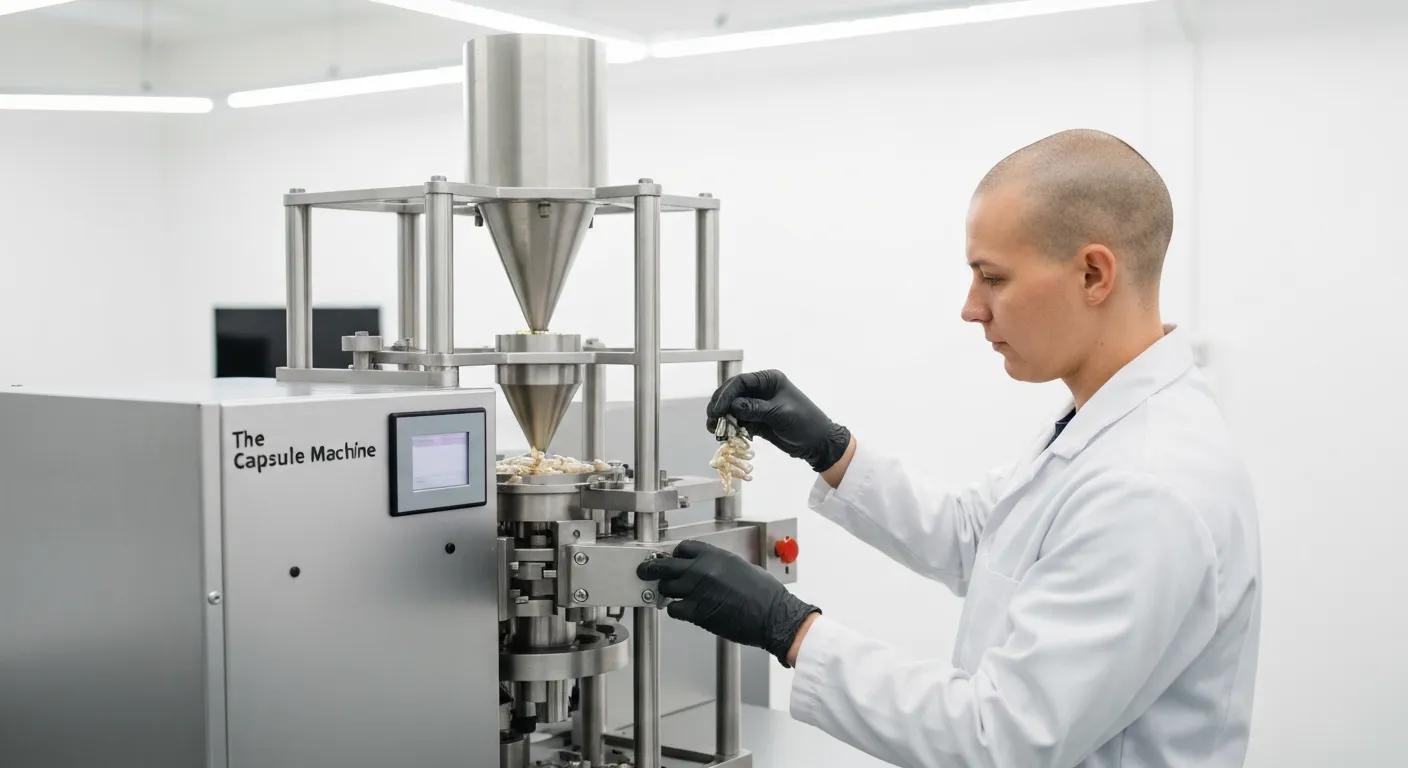
Filling vegan capsules with The Capsule Machine speeds small‑batch production and improves dose consistency compared with fully manual filling. The device aligns capsule bodies, controls dosing, and supports tamping cycles that mimic small production lines, a practical bridge between hand filling and contract manufacturing. Below you’ll find equipment setup guidance, a stepwise filling workflow, and material‑specific tips to limit moisture exposure and maximize yield.
What is the Capsule Machine and how does it simplify DIY supplement production?
The Capsule Machine is a bench‑scale filler built for small batches. It accepts multiple capsule sizes and works with vegetable shells such as HPMC and pullulan, enabling rapid prototyping and short runs without heavy capital outlay. Standardized dosing plates and tamping options improve weight consistency and reduce operator variability, making it a good fit for clinics, indie brands, and product developers who need reliable fills without outsourcing.
Numbered step-by-step filling workflow using The Capsule Machine
- Prepare environment and materials: Work in a clean, dry area and set the humidity to the level recommended for your capsule material.
- Set up capsules and dosing plate: Load empty capsule bodies into the machine and fit the dosing plate that matches your capsule size.
- Dose and tamp: Spread powder across the plate, use sifting and tamping to reach your target fill weight and density.
- Join caps and bodies and inspect: Close capsules, perform sample weight checks, and transfer finished capsules into sealed packaging.
What are the best practices for filling HPMC and pullulan capsules efficiently?
Environmental control is critical: keep relative humidity low enough for pullulan to avoid tackiness and at moderate levels for HPMC to prevent brittleness. Use anti‑static measures, correct sifters, and gentle tamping to avoid over‑compacting hygroscopic powders. After filling, store capsules in sealed, desiccated containers or use oxygen absorbers for oxygen‑sensitive formulations. Routine equipment cleaning, sample weight checks, and basic process documentation will keep fills reproducible as you scale.
- Control humidity during filling to protect capsule integrity.
- Use consistent tamping to achieve repeatable fill weights.
- Run sample weight checks on each production batch to ensure quality.
Capsule Connection supplies vegetable capsules and capsule filling equipment (including The Capsule Machine) and offers wholesale options for individuals and small businesses. We combine consumables and tooling to help small producers prototype and scale short‑run production with fewer vendors to manage.
Where and how to buy bulk vegan capsules for small businesses?
Choosing a supplier involves comparing MOQs, lead times, documentation, capsule material options, and capsule filling equipment availability. Samples help confirm stability and performance before making large purchases.
Common purchase options:
- Small batch wholesale: good for clinics and indie brands
- Pallet scale wholesale: better for established retailers
- Equipment plus supplies: ideal for in-house scaling
How Capsule Connection supports buyers?
Capsule Connection provides vegetable capsules, HPMC capsules, pullulan capsules, and capsule-filling equipment like The Capsule Machine. Their wholesale options serve individuals, clinics, and small businesses that want dependable supply and short-run production support.
Assessing purchase options for bulk vegan capsules
| Purchase Option | MOQ / Lead Time / Price Tier | Best For |
|---|---|---|
| Small-batch wholesale | Low–moderate MOQ; standard lead times; mid-tier pricing | Startups and clinics testing formulations |
| Pallet/large wholesale | Higher MOQ, longer lead time, lower unit price | Established brands and retailers with steady demand |
| Equipment plus supplies package | Variable MOQ; coordinated lead time for machine and consumables | Small manufacturers scaling in-house production |
This table clarifies how buying options align with operational scale and cash flow considerations.
What wholesale options does Capsule Connection offer for vegan capsules?
Capsule Connection offers empty vegetable capsules and capsule filling machines with wholesale options tailored to individuals, clinics, and small businesses. Our approach pairs supply (capsules) with tooling (filling equipment) so small producers can set up reliable short‑run production without juggling multiple suppliers. That integration simplifies procurement and gets teams into production faster.
How can healthcare providers and supplement businesses benefit from bulk purchases?
Buying in bulk lowers unit costs, secures a consistent supply for recurring patient or client needs, and speeds fulfillment for private‑label or clinic‑dispensed products. Clinics and small brands gain inventory predictability, more control over packaging for shelf life, and leverage to request documentation or traceability needed by regulators or retailers. Consolidating capsule and equipment sourcing reduces onboarding friction and frees time for formulation and marketing work.
- Verify supplier documentation and traceability before committing.
- Order samples to test compatibility and packaging outcomes.
- Match MOQ and lead times to your sales forecast to avoid stockouts.
These procurement practices help healthcare providers and small brands manage inventory risk while maintaining product quality.
If you’re exploring development or marketing partnerships, Capsule Connection welcomes inquiries to discuss supply, equipment, and scaling support for small‑scale production.
What are the latest trends and sustainability benefits of vegan capsules in supplements?
Market demand is shifting toward clean‑label, plant‑based delivery formats as consumer interest in veganism, allergen avoidance, and sustainability grows. Retailer and consumer expectations for traceability and transparent sourcing are rising, pushing brands toward suppliers who can document origins and certifications. Plant‑derived capsules use renewable feedstocks like cellulose and tapioca and can offer biodegradability advantages compared with some synthetic options but sustainability claims should always be backed by traceability and third‑party documentation. The sections below outline market drivers and lifecycle considerations to help brands responsibly articulate sustainability positioning.
How is the vegan capsule market growing and what drives consumer demand?
Growth is driven by rising vegan and flexitarian populations, stronger interest in clean‑label supplements, and retail appetite for ethically sourced products. Industry analyses show steady expansion of plant‑based excipients as formulators move away from gelatin, especially in premium and natural segments. These trends encourage suppliers to expand vegetable capsule offerings and support brands seeking differentiation through vegan certification and transparent sourcing. Understanding these drivers helps suppliers and brands plan inventory and supply‑chain decisions.
Why are plant-based capsules considered eco-friendly and ethically sourced?
Plant-based capsules come from renewable feedstocks, cellulose from plant pulp or pullulan from fermented starches, which reduces dependence on animal agriculture and supports ethical sourcing narratives. Lifecycle benefits can include lower direct animal impacts and potentially more sustainable raw material procurement when suppliers apply responsible practices.
Still, eco‑friendly claims should be supported by verifiable traceability and third‑party documentation because outcomes depend on farming practices, manufacturing energy use, and packaging choices. Brands that combine transparent sourcing with proper certification build stronger consumer and retailer trust.
- Consumers increasingly prefer supplements with clear, plant‑based ingredient lists.
- Sustainability claims carry more weight when backed by supplier traceability and certification.
- Market growth favors suppliers who can provide technical documentation and scalable logistics.
These sustainability trends give brands an opportunity to differentiate on ethics and transparency while meeting functional stability needs.
For development or marketing partnership conversations, contact Capsule Connection to discuss how our supplies and equipment can support product development, scale‑up, and retail readiness.
Frequently Asked Questions
What are the environmental benefits of using vegan capsules?
Vegan capsules made from plant materials like HPMC and pullulan are produced from renewable resources, reducing reliance on animal agriculture and its associated impacts. They can be more biodegradable than some synthetic alternatives, helping reduce plastic waste in certain contexts. Choosing plant‑based capsules supports sustainability messaging and appeals to eco‑conscious customers, provided your claims are backed by traceability and documentation.
How do vegan capsules affect the bioavailability of supplements?
Capsule material can influence the release profile of an ingredient. HPMC and pullulan both dissolve in the gastrointestinal tract and generally allow efficient release of actives. Selecting the right material and ensuring proper dissolution characteristics helps formulators preserve bioavailability, particularly for sensitive or specially formulated fills.
Can vegan capsules be used for liquid fillings?
Yes, vegan capsules can be used for liquid fills, but you must consider the material and sealing. Pullulan’s stronger oxygen barrier and film properties make it more suitable for certain liquid or oil‑based formulations, while sealing methods and packaging must prevent leakage. Test prototypes thoroughly to confirm long‑term integrity.
What certifications should I look for when purchasing vegan capsules?
Key certifications to request include vegan, kosher, halal, and non‑GMO, where relevant. These validate dietary suitability and boost consumer trust. Also, request supplier traceability documents and batch certificates to confirm sourcing and manufacturing practices, which are often required by retailers and regulators.
How do I ensure the quality of bulk vegan capsules?
Evaluate suppliers for certifications, manufacturing controls, and stability data. Request samples to test compatibility with your formulation and check physical properties. Perform routine quality checks on incoming product moisture content, visual inspection, and dissolution testing where appropriate, and build supplier relationships that include reliable documentation and support.
What are the common challenges when filling vegan capsules?
Common issues include moisture sensitivity and inconsistent fill weights. HPMC can become brittle under the wrong humidity, while pullulan may get tacky in high moisture. Control the environment humidity, use proper tamping and sifting techniques, and train operators on consistent workflows. Regular process checks and documentation minimize variability and improve yield.
Conclusion
Empty vegan capsules give your supplements dietary inclusivity, cleaner labeling, and broader market access. Knowing the strengths and limits of HPMC versus pullulan helps you choose the right shell for your formulation and shelf‑life goals. Prioritize traceability and certification to back ethical and sustainability claims, and lean on tested suppliers to reduce risk. Explore our selection of high‑quality vegan capsules and filling equipment to move from prototype to short‑run production with confidence.
