
Capsule Filling Machine Advantages: How to Boost Efficiency, Accuracy, and Business Growth

If you’ve ever tried to scale capsule production with manual methods, you already know how quickly bottlenecks pile up. Slow filling. Inconsistent weights. Extra waste. Missed deadlines. A capsule filling machine solves all of that by giving you a controlled, repeatable system built to handle higher volumes with ease. It turns a labor-heavy task into a streamlined operation that supports faster turnaround, reliable quality, and more room for growth.
In this article, you’ll learn how these machines improve speed, accuracy, hygiene, and day-to-day efficiency. You’ll also see how different machine types match different production levels, what capsule sizes and materials they work best with, and how to calculate realistic cost savings. Whether you’re a small maker ready to scale or a growing brand adding new SKUs, this guide shows exactly how capsule filling machines create a smoother path to sustainable expansion.
What Are the Key Efficiency Benefits of Capsule Filling Machines?
Capsule filling machines offer clear efficiency gains for any team looking to speed up production and remove the bottlenecks caused by manual work. By automating feeding, dosing, and multi-station handling, they deliver consistent output at a rate that manual methods simply can’t match. This increased efficiency supports better capacity planning, shorter lead times, and more freedom for operators to focus on quality control and product improvement rather than repetitive tasks.
Here are the three core efficiency benefits and how they impact daily operations:
- High throughput: A single operator can produce far more capsules per hour without increasing labor needs.
- Faster changeovers: Modular components and simple tooling help switch between SKUs quickly and reduce downtime.
- Predictable scheduling: Automated cycles lower variability, making production planning and on-time fulfillment much easier.
These advantages reduce operational friction and set the foundation for improved production speed in the next section.
How Do Capsule Filling Machines Accelerate Production Speed?
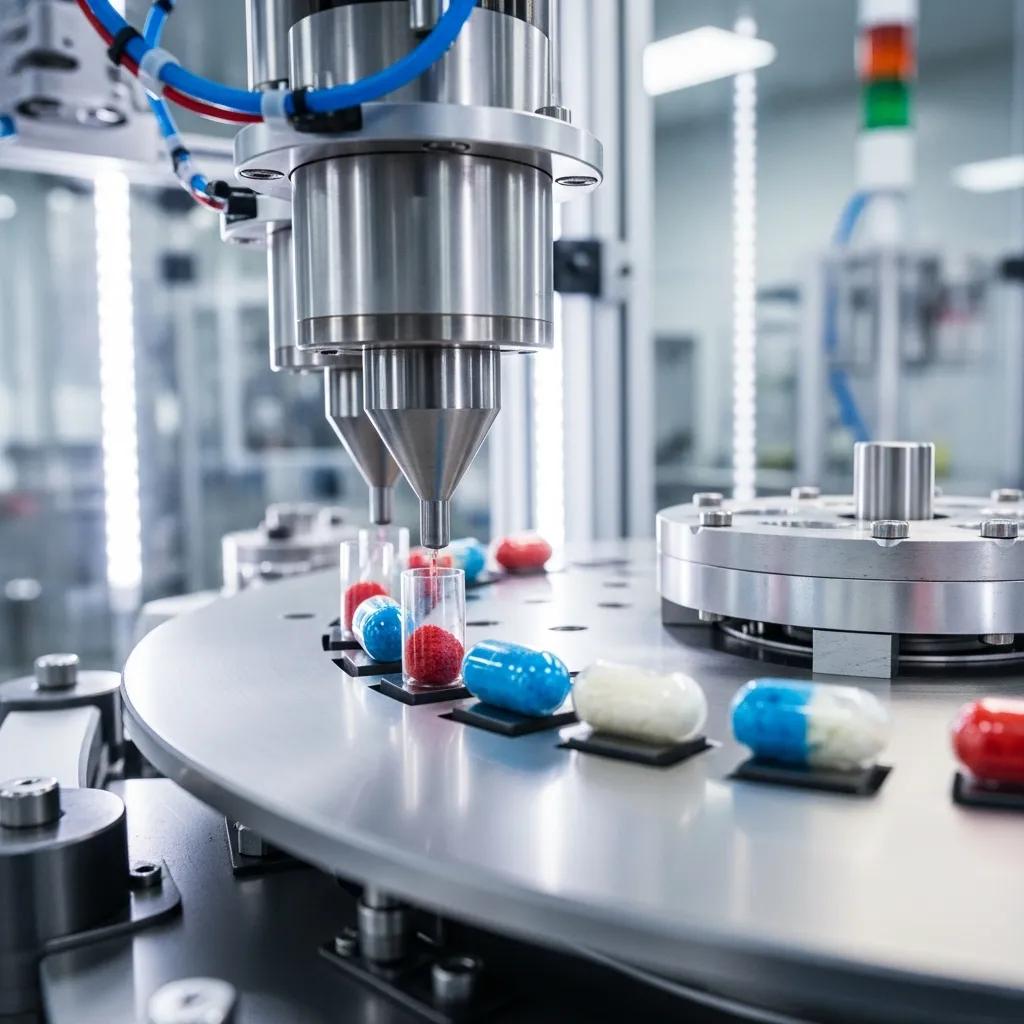
Capsule filling machines accelerate speed by combining mechanical motion with continuous material handling to reduce idle time between fills. Carousel or rotary platforms load and orient capsules while dosing systems simultaneously fill positions, enabling thousands of capsules per hour on semi-automatic and fully automatic models. Typical throughput ranges vary by class: manual fillers are suited to low volumes, semi-automatic units often deliver hundreds to low thousands of capsules per hour, and high-capacity automatic machines reach several thousand per hour, supporting contract manufacturers and high-volume supplement lines. Production speed improves when hopper capacity, dosing mechanism, and ejection rates are optimized together, producing a smooth flow from bulk powder to packed capsules. A faster filling cycle shortens order lead times and allows more SKUs to be produced within a given week, which is especially valuable when scaling product catalogs.
In What Ways Does Automation Reduce Labor and Downtime?
Automation reduces labor by eliminating repetitive manual tasks like capsule joining, manual dosing, and repeated tamping, replacing them with synchronized mechanical actions that require supervision rather than constant operator input. Labor savings typically appear as fewer operator-hours per thousand capsules and more predictable staffing needs during production runs. Automation also reduces downtime through repeatable tool changes, built-in hopper feed, and simplified cleaning cycles that shrink setup and maintenance windows. Reduced human touchpoints mean fewer opportunities for operator error and rework, improving first-pass yield and lowering per-unit labor costs. These labor and downtime improvements naturally lead to the next topic: how machines maintain dosage accuracy and consistent product quality.
How Do Capsule Filling Machines Ensure Accurate Dosage and Consistent Quality?
Capsule filling machines ensure accurate dosage and consistent quality by using dedicated dosing systems, controlled tamping, and repeatable mechanical tolerances that minimize batch-to-batch variability. Dosing cams, auger or tamping systems, and adjustable feeders provide predictable measured volumes while enclosed hoppers and controlled discharge reduce powder segregation and dust. Quality control mechanisms, such as in-process weight checks and rejection gates, maintain uniformity and reduce off-spec product. The table below compares typical dosing accuracy and hygiene controls across machine classes to clarify trade-offs between manual and automated approaches.
| Machine Class | Typical Dosing Accuracy | Contamination Controls |
|---|---|---|
| Manual filler | Moderate (higher variance) | Basic, operator-dependent cleaning |
| Semi-automatic | Good (narrower tolerances) | Enclosed hoppers, easier cleaning |
| Automatic high-capacity | High (tight tolerances) | Enclosed dosing, dust extraction, and integrated QC |
This comparison shows how upgrading from manual to automatic equipment tightens tolerances and strengthens contamination controls, which directly reduces returns and regulatory risk. Understanding the specific precision features that support accuracy explains these differences further.
What Precision Features Improve Dosage Accuracy in Manual and Automatic Machines?
Key precision features include dosing cams and tampers, as well as auger or piston dosing systems, adjustable feeders, and electronic controls that fine-tune fill weight and volume. Dosing cams and tampers physically shape and compress powder consistently; auger and piston systems meter volumetric flow to tight tolerances; electronic feedback and touchscreen controls allow operators to set and lock parameters for repeatable output. In manual systems, accuracy depends heavily on the operator's technique, whereas semi-automatic and automatic machines incorporate consistent mechanical motion and programmable settings that reduce variance. Dosing cams → improve → dosage accuracy by standardizing motion; electronic control → enforces → set tolerances, which together deliver reliable fill weights. These precision mechanisms also relate to hygiene design, which ensures consistent quality during extended production runs.
How Do Capsule Filling Machines Maintain Hygiene and Safety Standards?

Hygiene and safety are maintained through material choices, enclosed systems, and maintenance protocols that reduce contamination risk and simplify validation. Food- and pharmaceutical-grade stainless steel parts, quick-release components for cleaning, and enclosed dosing hoppers minimize contact and airborne dust, while simple disassembly reduces downtime for cleaning. Recommended practice includes validated cleaning-in-place procedures, routine inspection of seals and gaskets, and documented sanitation cycles to meet GMP-style expectations. By combining hygienic design with scheduled maintenance, manufacturers lower contamination risk and support consistent product integrity. Maintaining these standards also reduces regulatory exposure and contributes to higher consumer trust for finished products.
What Cost Savings and ROI Can Businesses Expect from Capsule Filling Machines?
Businesses can expect cost savings from three main areas: reduced labor, lower material waste, and faster production cycles. Machines replace repetitive manual work with streamlined, consistent operation, which lowers operator hours per batch and improves yield. These gains make it easier to scale production without increasing staffing or extending lead times. Typical ROI drivers include:
- Labor savings: Up to 30–70% fewer manual hours needed for filling tasks.
- Material waste reduction: More accurate dosing can cut powder loss by 10–25%.
- Lower downtime: Faster setup and SKU changeovers reduce idle time by 20–50%.
- Fewer quality issues: More consistent fills mean fewer rejects, returns, and rework.
Together, these improvements raise per-unit margins and shorten the payback window for new equipment. Higher throughput also increases revenue potential without increasing overhead, which strengthens long-term ROI for both small batch producers and larger operations.
| Cost Factor | Impact on Cost | Example Metric |
|---|---|---|
| Labor | Lowers operator-hours per batch | 30–70% reduction in manual labor for fill tasks |
| Material waste | Reduces scrap and overfill | 10–25% less powder loss vs manual filling |
| Downtime | Shorter setup and changeovers | 20–50% faster changeovers |
| Quality failures | Fewer rejects and rework | Reduced returns and customer complaints |
How Does Waste Reduction Maximize Profitability?
Waste reduction improves profitability by lowering the cost of goods sold and increasing effective yield from the same raw material purchases. Sources of waste in manual filling include powder spillage, capsule breakage, and excess overfill; machines address these with enclosed feed paths, gentle handling, and precise dosing. For example, reducing waste by 10% on a high-cost active ingredient directly increases margin on each batch and shortens the payback for equipment. Process controls and in-line rejection minimize off-spec units, decreasing the need for rework and saving labor hours. These improvements compound over multiple batches, contributing to a measurable uplift in annual gross margin and supporting reinvestment into growth activities.
What Are the Long-Term Financial Benefits of Investing in Capsule Filling Machines?
Long-term benefits include lower per-unit production costs, predictable capacity expansion, and the ability to pursue new revenue channels by offering faster fulfillment and consistent quality. Depreciation and maintenance should be included in a multi-year TCO model, but the net effect commonly shows improved margin as volume increases. Scalability means businesses can add SKUs or contract work without proportional increases in headcount, and consistent quality reduces customer churn and returns. Non-financial returns, faster time-to-market, improved brand reliability, and the ability to leverage ethical sourcing messages also enhance customer acquisition and retention over time, creating compounding value beyond immediate cost savings.
How Do Capsule Filling Machines Adapt to Different Business Needs and Capsule Types?
Capsule filling machines adapt to business needs through modular tooling, adjustable dosing systems, and compatibility with a wide range of capsule sizes and materials. Machine classes map to volume and budget constraints: manual machines suit low-volume development runs, semi-automatic units support growing brands, and automatic profilers handle scale and contract requirements. Compatibility depends on capsule size (00–5), material (gelatin vs vegetable), and specialty properties (enteric coatings or joined capsules), so choosing the right machine often requires a compatibility check. The table below provides a concise capsule compatibility matrix to help match capsule types to machine classes and recommended models.
| Capsule Size / Type | Compatible Machine Types | Recommendation / Notes |
|---|---|---|
| Size 00–0 | Manual capsule filling machine, Semi-auto, Automatic | Most machines support these standard sizes |
| Size 1–3 | Manual, Semi-auto, Automatic | Good compatibility; adjust tooling as needed |
| Size 4–5 | Semi-auto, Automatic | Smaller sizes may require fine-tuned dosing |
| Gelatin capsules | All classes | Standard handling and tooling |
| Vegetable capsules | All classes (with gating) | Ensure moisture controls for brittle shells |
This compatibility mapping helps businesses evaluate which machine class fits both current production and future growth scenarios. The next subsection gives a practical decision framework to choose between manual and automatic equipment.
Which Capsule Sizes and Types Are Compatible with Manual and Automatic Machines?
Standard capsule sizes 00 through 5 are compatible across manual capsule filling machines, semi-automatic, and automatic classes, with tooling adjustments required for specific diameters and shell tolerances. Gelatin and vegetable capsules are both supported by most machines, but vegetable shells may be more brittle and benefit from gentler handling and humidity control. Specialty capsules like enteric-coated or joined capsules might need verification for feed geometry and sealing methods before committing to high-speed production. When evaluating equipment, request compatibility checks for the precise capsule brand and formulation to ensure smooth scale-up. Confirming compatibility early prevents expensive tooling changes and secures predictable batch yields.
How to Choose Between Manual and Automatic Capsule Filling Machines for Your Business?
Choosing between manual and automatic machines depends on forecasted volume, budget, staff capacity, and growth plans; follow this three-step checklist to decide:
- Estimate monthly capsule volume and project growth over 12–24 months.
- Compare per-unit labor and waste costs across manual vs automatic scenarios.
- Assess the budget for capital expenditure and the expected payback timeline.
Manual machines fit low-volume testing and early-stage brands; semi-automatic units support steady growth with moderate capital, and automatic machines suit high-volume, multi-SKU operations. For actionable guidance, map your projected volumes to throughput ranges and examine how faster production unlocks marketing opportunities and contract work.
Why Partner with Capsule Connection for Your Capsule Filling Machine Needs?
Capsule Connection presents a product lineup that spans entry-level to production-grade machines while emphasizing USA-made quality for its proprietary The Capsule Machine and a ProFiller series designed for scaling throughput. The vendor messaging highlights the lowest price & best quality, and their documented charitable donations of over 80% of profits donated since 2016 offer a distinctive ethical signal that brands can integrate into their marketing. Partnering decisions should weigh equipment performance, local manufacturing advantages, and the potential to co-create development or marketing campaigns that leverage social-impact narratives to attract customers and partners. Below is a brief value proposition list and a short call-to-action tailored for teams focused on growth and client acquisition.
- USA-made proprietary offering: The Capsule Machine emphasizes domestic manufacturing and quality control.
- Scalable ProFiller series: ProFiller 1100, 3600, and 3700 map to increasing throughput needs.
- Ethical partnership: Over 80% of profits donated since 2016 can support client brand storytelling.
If your primary objective is getting new development or marketing clients, consider engaging Capsule Connection to align equipment selection with your production roadmap and co-marketing opportunities; a consultative discussion can connect machine capabilities to your go-to-market strategy and help position capacity, quality, and social purpose in sales collateral and outreach.
How Does Capsule Connection’s USA-Made Quality and Service Stand Out?
The Capsule Machine is explicitly presented as USA-made, which often signals closer manufacturing oversight, easier access to replacement parts, and the possibility of faster service responsiveness compared with distant suppliers. Buyers should confirm warranty, spare parts availability, and training options when evaluating vendors, and prioritize machines with straightforward maintenance and accessible documentation. USA manufacturing can also streamline compliance logistics for clients selling domestically, providing a clearer chain-of-custody for product claims. Prospective partners should ask specific service and support questions to ensure uptime targets and maintenance windows align with production goals.
What Is the Impact of Capsule Connection’s Charitable Donations on Your Business Partnership?
Capsule Connection’s practice of donating over 80% of profits to charitable groups since 2016 creates a clear ethical differentiator that clients can incorporate into marketing narratives and corporate purpose statements. Partnering with a vendor that foregrounds social impact can enhance brand positioning for clients seeking to attract ethically minded customers or B2B partners. When crafting partnership messaging, teams can highlight joint commitments to quality and community impact without overstating claims, using the donation history as a factual support point in storytelling. Integrating social-responsibility messaging can amplify outreach to retailers, distributors, and end consumers who prioritize values-aligned suppliers.
- Assess alignment: Determine how the vendor’s charitable focus supports your brand values.
- Co-create messaging: Develop marketing narratives that combine product quality with social impact.
- Measure response: Track lead generation and client interest attributable to ethical positioning.
This approach helps convert operational investments into marketing differentiation that supports business development and client acquisition goals.
Conclusion
Investing in a capsule filling machine significantly enhances production efficiency, accuracy, and overall business growth. By automating the filling process, businesses can reduce labor costs, minimize waste, and ensure consistent quality, ultimately leading to higher profitability. Understanding the various machine types and their compatibility with different capsule sizes allows for tailored solutions that meet specific production needs. Explore our range of machines today to find the perfect fit for your business and unlock your growth potential.
